Four kinds of affiliate publisher, and what they really do for you
Not every publisher is the same. Content sites build trust, comparison sites structure choice, cashback sites reward loyalty, and coupon sites often just take the margin. An honest comparison.
 By Diederik van Korven
·
·
4 min read
By Diederik van Korven
·
·
4 min read
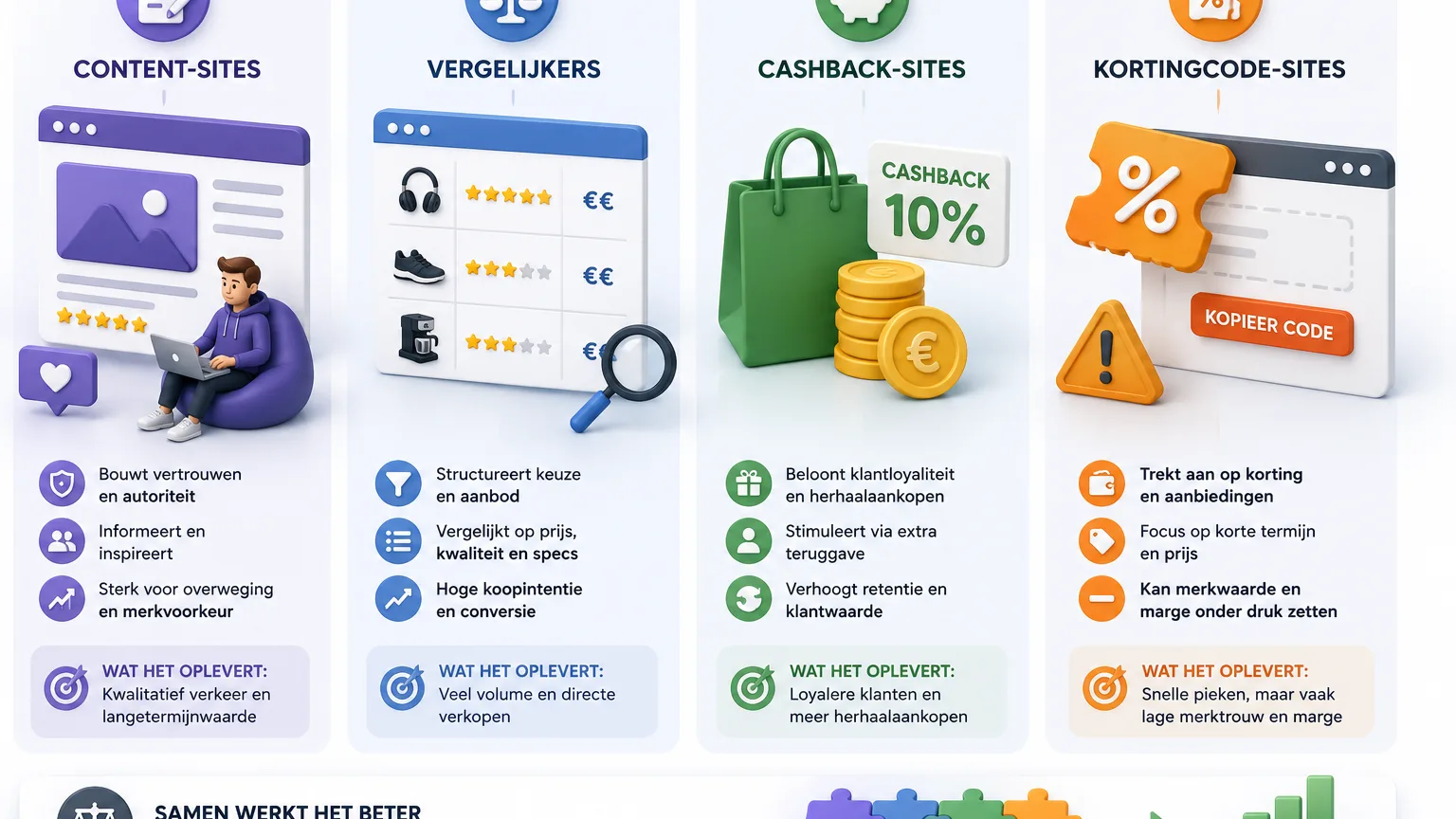
"Affiliate publisher" is not a job title but a catch-all. Under that umbrella sit parties with barely anything in common, in terms of audience, visitor behaviour or value to the advertiser. An advertiser or a new network that does not know which types exist will blindly accept everyone who applies, and then watch the commission budget leak away to the wrong parties.
An honest explanation of the four main types: what they do, who they add value for, and what to watch out for.
1. Content publishers
What they do: write articles, make videos, build comparisons, send newsletters. Their affiliate links sit inside content readers come to voluntarily: a product review, "the best laptop under €1,000", a how-to guide that recommends a tool.
Which stage of the funnel: early to middle. The reader is orientating, hesitating, comparing. The content publisher helps form the decision.
Value to the advertiser:
- Builds demand that would not have existed without them
- Quality traffic (the reader is interested in the subject, not just in a bargain)
- Long tail: articles keep drawing traffic for years
What to watch out for:
- A lot of noise, from excellent SEO editorial teams to AI-generated "review" factories
- A good publisher management team judges not only on traffic but on editorial quality and relevance
2. Comparison sites
What they do: structure choice. Side-by-side overviews of products or services with sorting, filtering, reviews and price updates. Think energy comparison sites, telecom comparison sites, hotel rooms, insurance.
Which stage of the funnel: middle to late. The visitor knows what they want (a new energy supplier), but not yet which one. The comparison site helps make the choice.
Value to the advertiser:
- Traffic with high intent, reasonably familiar with the market
- Good for brand positioning: being at the top of a comparison counts
- Dataset driven: comparison sites often work from product feeds, so updates flow automatically
What to watch out for:
- Comparison bias: some comparison sites quietly sort on commission rather than relevance
- Good comparison sites are transparent about their ranking logic; less good ones are not
- Product feed quality is essential here, more about that in Affiliate feeds: how to build a product feed publishers can actually use
3. Cashback sites
What they do: promise the consumer part of the amount back on every purchase. Known from platforms such as TopCashback, Tweakers Cashback (RIP) and international players like Rakuten.
Which stage of the funnel: late. The consumer has decided to buy and first clicks through the cashback site to pick up the "discount".
Value to the advertiser:
- Customer loyalty: cashback members come back because the account is part of the deal
- Predictable traffic that often converts well (intent is very high)
- Useful for competing on brands that hand out few discount codes
What to watch out for:
- Cannibalisation: as with coupon sites, the question is whether the purchase would have happened without the cashback
- Good cashback platforms show the advertiser honestly which purchases are net new customers (incrementality)
- Margin impact: the cashback percentage comes out of the advertiser's commission, so does the ROI target still hold?
4. Coupon sites
What they do: publish codes that give discounts in webshops. Sometimes exclusive, often simply borrowed, regularly expired.
Which stage of the funnel: the very last moment. The visitor is already in the checkout, quickly searches for a code, and unknowingly picks up a fresh affiliate cookie.
Value to the advertiser:
- On paper: extra revenue
- In reality: often zero to negative, because the purchase would have happened without them too, and the margin is halved by both the discount and the commission. See Why Klatsa does not allow coupon sites for our full opinion.
What to watch out for:
- Hijacking of content publisher credit: visitors convinced by a genuine content publisher still find a coupon site on the checkout page, and the credit disappears
- Code leakage: exclusive codes you issued for one specific campaign leak through these sites to the whole internet
A healthy publisher mix
For most advertisers the ROI lies in a combination:
- Content publishers for brand building and winning net new customers
- Comparison sites for structuring choice and being present in the consideration stage
- Cashback to a limited extent, with sound attribution rules
- Coupon sites: deliberately and tracked, or better still: not at all (our advice)
At Klatsa we see ourselves as a gatekeeper: we approve publishers individually on the basis of what they add, not on whether they can generate clicks. That costs the network revenue in the short term, but it makes our advertisers happier in the long term, and that is ultimately what the network exists on.