Why Klatsa does not allow coupon sites
Coupon websites take a commission at the very end of the funnel, where they add almost no value. Bad for the advertiser, bad for the content publisher who did the real work. Which is why we do it differently.
 By Jeroen Jaspers
·
·
4 min read
By Jeroen Jaspers
·
·
4 min read
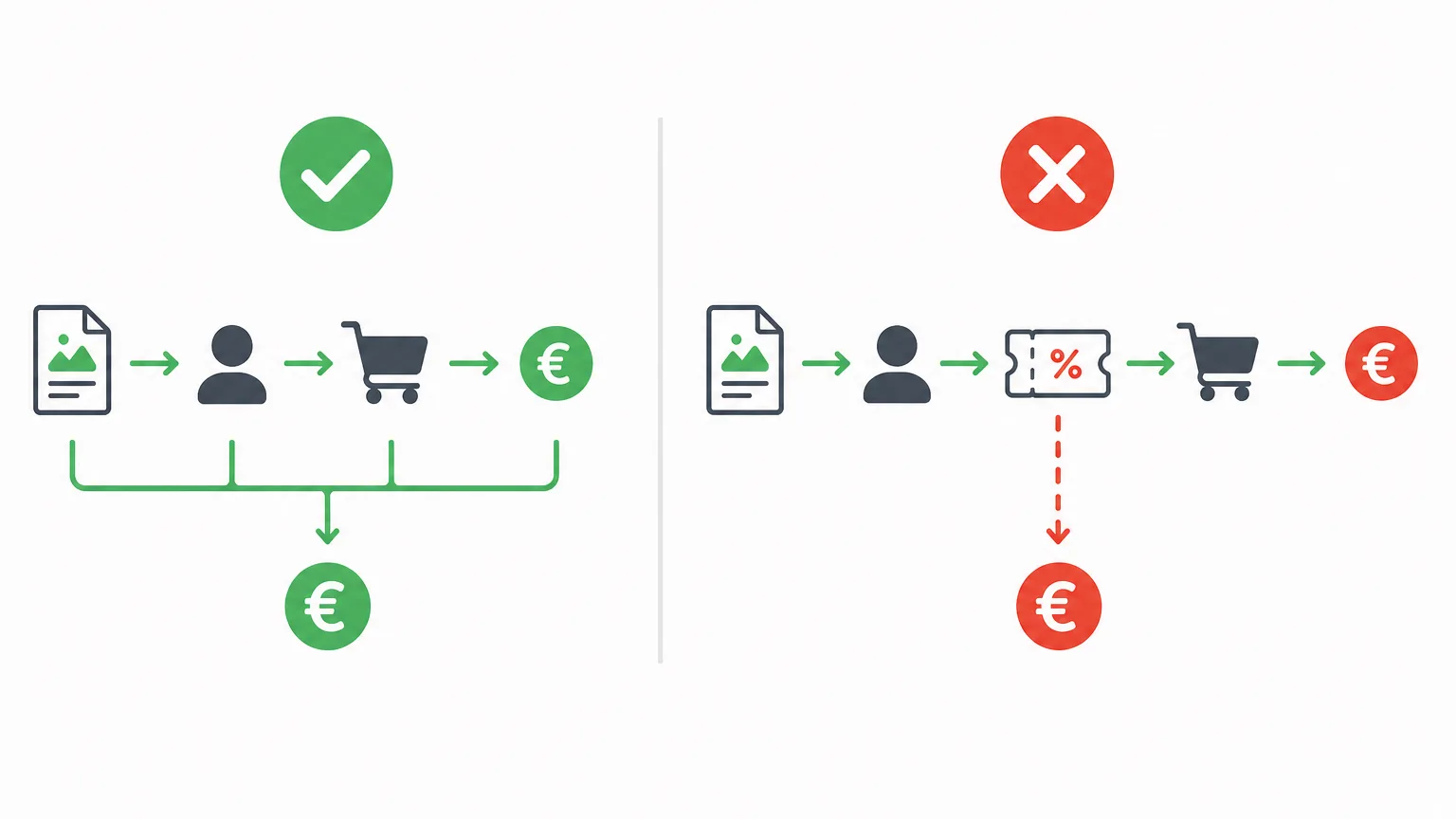
Picture this: a reader sees a good article on a review site, clicks through to a webshop, fills their basket and heads for the checkout. And there it is, that treacherous field: "Do you have a discount code?". The reader does what everyone does: a new tab, a search for "shopname discount code", a landing on a coupon site, a click on a (often expired) code, and with that they unknowingly pick up a fresh affiliate cookie. The sale is settled, and the coupon site gets the commission.
The content publisher who did the real work gets nothing.
Why this is a problem
Affiliate marketing is a game of attribution. Who gets the credit for the sale? In most networks the answer is simple: last cookie wins. The last affiliate cookie set before the purchase gets the commission. That sounds fair, but in practice it works out like this:
- The content publisher (a review, a blog, a comparison site, a newsletter) does the persuading: capturing attention, building trust, generating the click.
- The coupon site steps in at the very last moment. The buying decision has already been made. Nobody needs convincing any more, a code just needs clicking.
The result: the coupon site earns without adding value. The content publisher earns less than they deserve. In the long run serious content publishers stop working with that advertiser, because the effort no longer pays.
And what about the advertiser?
To an advertiser this feels neutral at first, after all there is a paid sale. But look at it seriously:
- Margin erosion. The purchase would have happened anyway. So the discount code is pure margin skimming: cost without extra revenue.
- Code leakage. Codes meant for a specific campaign (a newsletter, retention, a deal mailing) leak to coupon sites and get used en masse by customers who would otherwise never have seen them.
- Losing content publishers. When content publishers earn less and less because coupon sites scoop up all the credit at the finish line, you eventually lose visibility with exactly the parties that do bring net new customers.
What the coupon industry actually does
Many coupon sites offer no exclusive codes at all. They scrape the web, rank high for "[shopname] discount code" and serve the same 5 codes you find everywhere, often expired. The traffic they attract consists almost entirely of people who had already decided to buy. The added value is zero at best, and often negative (abandoned checkouts caused by the hunt for a code that works).
How we look at this at Klatsa
Let us be honest: in the short term it is attractive for an affiliate network like Klatsa to accept coupon sites. It brings us more revenue, because coupon traffic converts easily, the buying decision having already been made.
But advertisers lose out. And when advertisers walk away, the network empties out. So we choose the long term.
Klatsa is a network that wants to add real value for advertisers and publishers. Which is why we do not allow coupon sites.
In concrete terms that means:
- Publisher applications whose business model consists mainly of scraped coupon codes are not approved.
- We actively curate our publisher base for parties that genuinely generate traffic: content, comparison sites with substantive reviews, newsletters with a real readership, communities with expertise.
- Advertisers at Klatsa know that their commission budget goes to partners who bring net new customers, not to parties that intercept the purchase at the finish line.
What if you do want to work with discount codes?
Couponing can work perfectly well, as long as it is deliberate and controlled. For example:
- Your own tracked campaign codes, distributed only through specific channels (email, your own social accounts).
- No affiliate credit when a coupon code is redeemed that was not obtained through a trackable affiliate click.
- Validation rules in your webshop that stop coupon sites getting credit for codes they did not generate themselves.
That kind of discipline is possible in your own affiliate stack, but few advertisers manage to get it past the large networks, which after all earn on every approved transaction.
At Klatsa we try to explain it from the point of view of the advertiser and the serious publisher. That is what we stand or fall by.